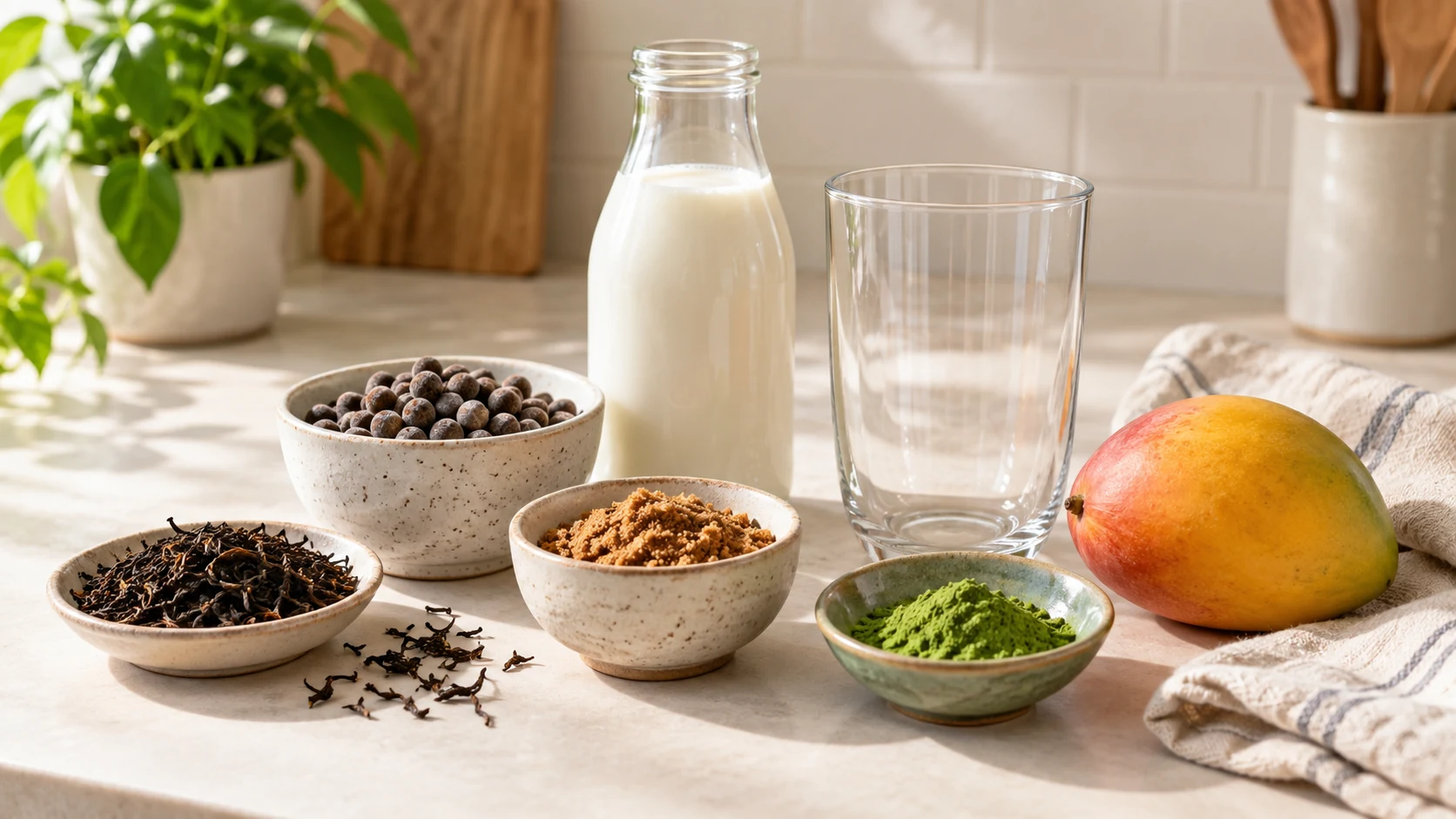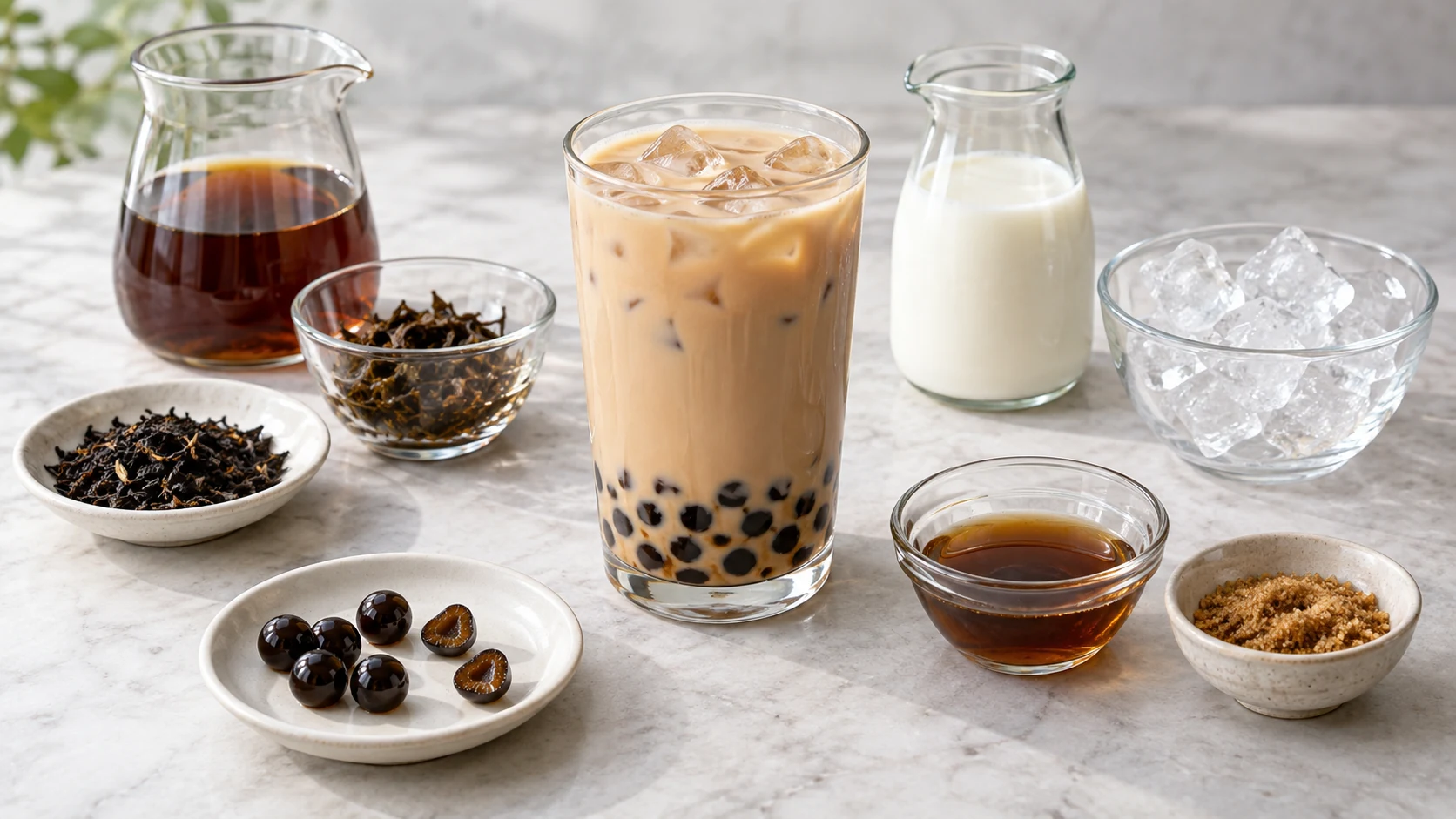
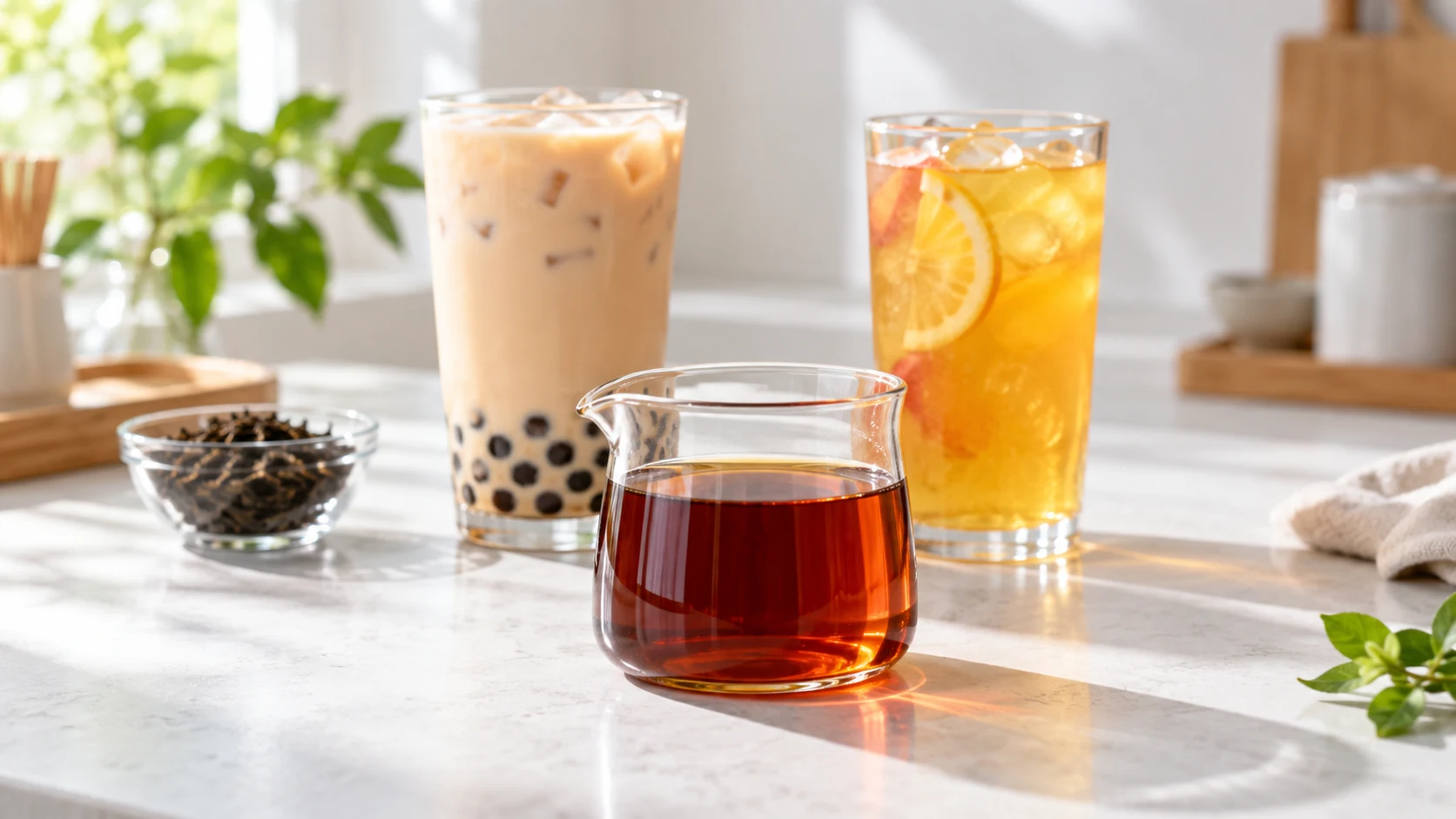
A tea that tastes balanced when hot can disappear after milk, fruit, sweetener, and ice enter the cup. Bubble tea therefore needs more than a normal mug of tea. It needs a base designed for its finished volume. The useful question is not simply, “How long should this tea steep?” It is, “How much tea flavor must remain after everything else is added?”
This guide gives sourced starting points, not a universal house formula. Tea type, leaf size, package instructions, water, and the intended drink all matter. Begin with the maker's directions when available, measure what you do, and change one variable per batch.
Define the finished cup first
Work backward from the drink you want to serve. Write down the final cup volume, then reserve space for every non-tea component.
For a 16-fluid-ounce milk tea, you might plan 6 ounces of tea, 4 ounces of milk, 1 ounce of sweetener, and enough ice to fill the remaining space. A fruit tea might use 8 ounces of tea, 2 ounces of puree or juice, a smaller sweetener addition, and ice. These are planning examples, not fixed recipes. Their purpose is to reveal how much brewed tea the cup actually contains.
If you brew a full 16 ounces of ordinary-strength tea and then add the other components, the cup becomes too large. If you brew only 6 ounces at ordinary mug strength, the tea may become hard to detect. That is why bubble-tea brewing links four variables: tea amount, water temperature, steep time, and dilution after brewing.
Tea families need different starts
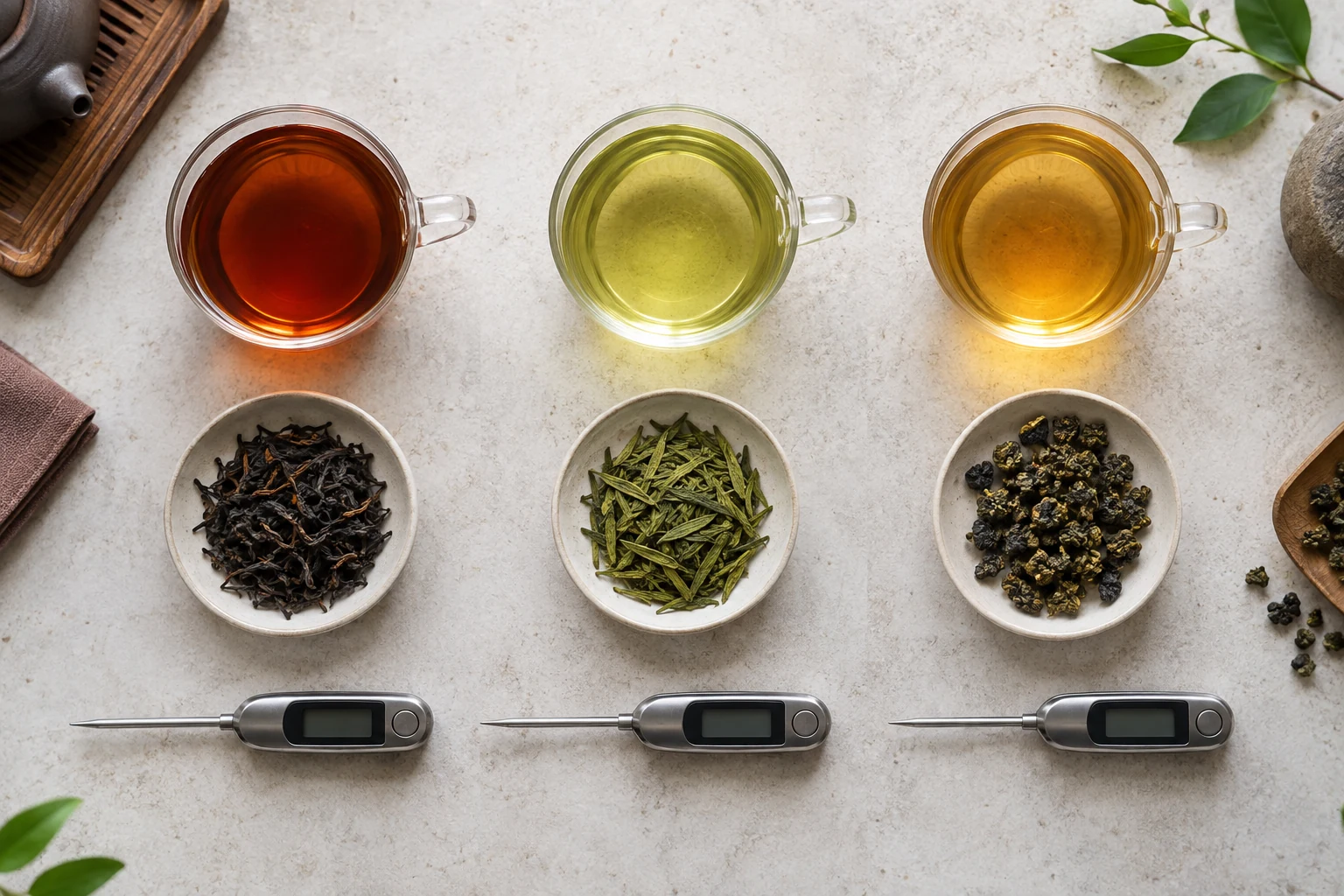
Use the directions for the exact tea first. When those are unavailable, producer guidance can supply a cautious starting range. Twinings recommends roughly 1 to 2 teaspoons of loose tea per 8 ounces of water. Its current guidance places black tea near boiling water with a 3-to-5-minute steep, green tea around 175 to 180 degrees Fahrenheit for about 2 minutes, and oolong around 195 degrees Fahrenheit for 2 to 3 minutes.
Those numbers are not interchangeable. Very hot water and a long steep that suit one black tea may make a green tea unpleasant. A tightly rolled oolong may also behave differently from a broken-leaf tea bag. Treat the range as a first measurement, then keep the tea identity and package directions in your notes.
Remove the leaves or tea bags when the planned steep ends. Leaving them in the cooling tea means extraction continues, so a base that initially seems balanced can become harsher before assembly.
Build concentration deliberately
When the finished drink tastes weak, adding more tea material is usually a cleaner next experiment than stretching steep time far beyond the suggested range. A longer steep can add intensity, but it can also change the kind of intensity. More leaf in the same measured water lets you strengthen the base while keeping temperature and time close to the producer's starting point.
Use a simple concentration plan:
- Choose the amount of brewed tea needed in the finished cup.
- Brew that water volume with the normal label amount of tea.
- Assemble one drink with measured milk, fruit, sweetener, and ice.
- If the tea disappears, repeat with 25 to 50 percent more tea material while keeping the water, temperature, and time unchanged.
For example, if a label calls for one tea bag per 8 ounces but the finished cup uses only 6 ounces of tea, start with one bag in 6 ounces rather than guessing at a very long steep. If that remains too light after assembly, try 1.5 bags or an equivalent measured amount of loose tea next time. Record the adjustment; do not keep adding leaves during the same brew.
Brew, strain, and stop extraction
Heat more water than the recipe needs so the measured brewing volume is accurate after the kettle and vessel are warmed. Measure the tea and water, start timing when they meet, and keep the vessel covered if the tea maker recommends it. At the end of the interval, remove bags or strain all leaves into a clean heat-safe container.
Taste a small spoonful before adding anything. The base should be more assertive than a ready-to-drink cup, but it should still taste like tea rather than only bitterness or dryness. This checkpoint helps separate a brewing problem from an assembly problem. If the plain base is already unpleasant, milk and sugar may hide it, but they do not correct it.
Do not squeeze a tea bag merely to chase the last liquid unless its maker recommends doing so. More pressure is another variable, and an unmeasured one makes the next batch harder to reproduce.
Plan for cooling and ice
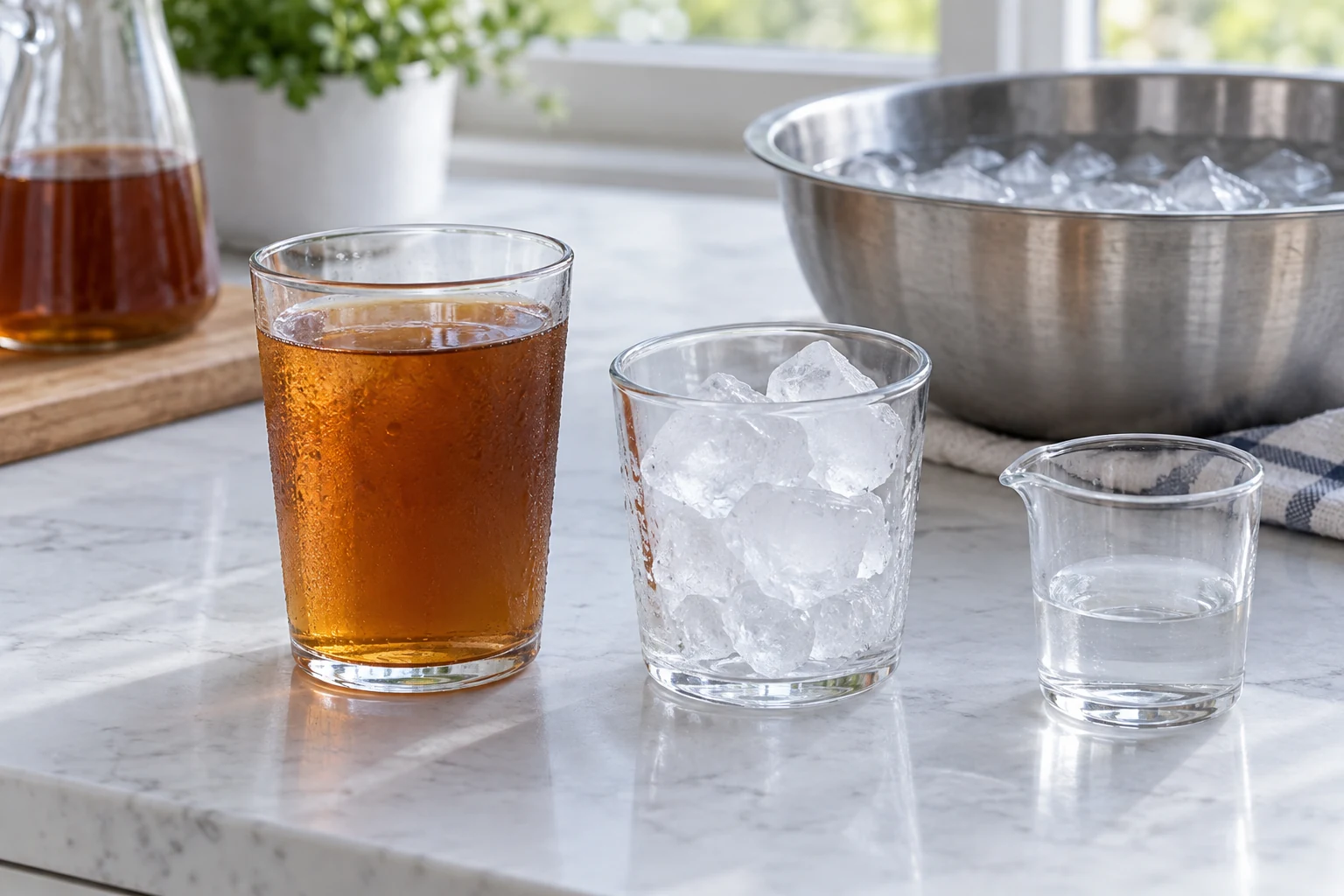
Hot tea melts ice immediately. That melt is water, so it belongs in the dilution plan. If a measured 6-ounce tea base is poured hot over a full glass of ice, the resulting drink may be much weaker than the arithmetic suggested.
The simplest home method is to brew first, remove the leaves, and cool the tea before final assembly. Use a shallow, clean container or an ice bath around the container to speed cooling. Do not leave a perishable finished drink sitting at room temperature while waiting for the tea to cool. The FDA advises refrigerating foods that require refrigeration within two hours and keeping the refrigerator at 40 degrees Fahrenheit, or 4 degrees Celsius, or below.
Another option is deliberate flash chilling: reserve a measured amount of ice as part of the tea's water. Brew with less hot water, then add the measured ice and stir until it melts. This requires a stronger concentrate and careful arithmetic; random handfuls of ice will not give a repeatable result.
Change one variable next time
Use the symptom to select one change.
- Weak after milk or fruit: increase tea material while holding time and temperature steady.
- Bitter before assembly: shorten the steep or verify that the water was not too hot for that tea.
- Strong before ice, flat afterward: cool the base before assembly or measure the ice melt.
- Fragrant but thin: reduce the non-tea volume before extending the steep.
Keep a five-line record: tea name, tea amount, water amount and temperature, steep time, and finished-cup additions. That small log turns the next drink into a controlled adjustment instead of another guess. The goal is not one “perfect” number. It is a tea base whose strength survives the exact cup you intend to build.
Sources
- How to Brew the Perfect Cup of Tea Twinings
- How to Make the Perfect Cup of Loose Leaf Tea Twinings
- Are You Storing Food Safely? U.S. Food and Drug Administration